What can a circle of tree stumps in Richmond Park teach us?
Taking a closer look
A Circle of Possibility
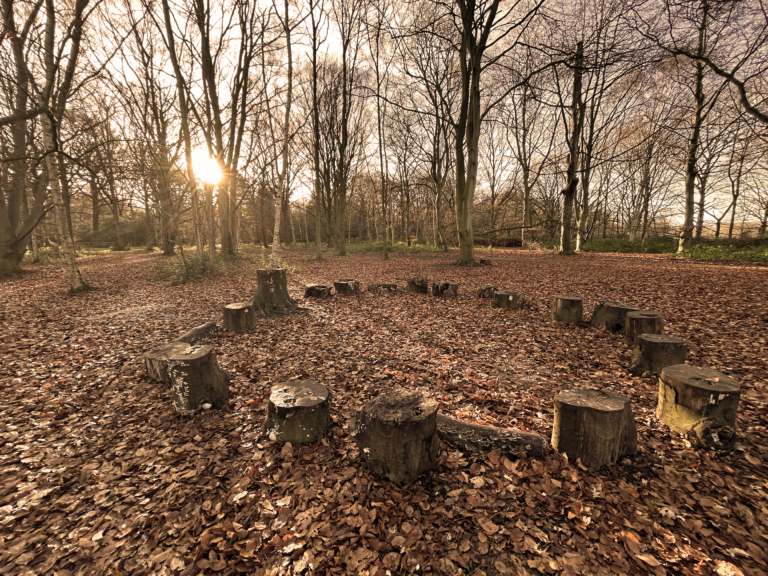
Looking at the picture, we can see the ring of tree stumps at Isabella Plantation. Sunlight lands on the cut surfaces, showing the rings of years passed. The ground between them is worn, a sign of use. This isn’t an art installation; it’s a functional space. A meeting point. In its simplicity, it mirrors a core idea in education: that the right environment can change how we think and interact.
For decades, the Forest School approach has used spaces like this. The philosophy holds that a natural, minimally structured setting (a circle of stumps, a patch of woods) can foster focus, resilience, and collaboration in ways that manufactured classrooms sometimes struggle to achieve.
Why a Circle? Why Stumps?
Analysing the photo and stumps arrangement in detail gives us more clues:
- The circle has no head: It puts everyone on equal footing, making conversation and shared attention the default. It’s a practical design for community.
- The stumps are not uniform: They’re solid, grounded, and require a slight physical engagement to sit on. This subtle act of balancing can help anchor a person in the present moment, cutting through distraction more gently than a command to “sit still” ever could.
- The space in the centre is open: It holds whatever the group needs it to – a project, a found object, or nothing at all. Its emptiness is its potential.
The Evidence is catching up
This week, a University of East London study covered by the BBC provided data supporting the interpretation of this scene. Researchers found that moving lessons outside consistently lowered noise levels and reduced children’s physiological stress.
The findings are practical: an average drop of 3 decibels in volume and 3 beats per minute in heart rate. Teachers reported that students were better able to regulate their own behaviour and engaged in tasks for longer. The outdoor environment itself seemed to provide the regulation that teachers often have to “manually” enforce indoors.
This research does not strictly validate Forest School but aligns with it on a key point: the physical environment for learning is highly significant.
A Portable Idea
You don’t need a designated plantation to grasp the concept. The value is in the principle of a dedicated, natural gathering spot(s). It could be a few logs in a garden, cushions under a tree, or stones by a stream. The goal is to create a defined space where attention can settle differently.
This photo captures a specific place, but its relevance is broad. In a world of high-stimulus learning, it presents a low-tech, high-effect alternative. It reminds us that sometimes the most effective tools for focus and collaboration are the simplest, most grounded ones we can find.