Hope is a seed that doesn’t wait
A Wish for the New Year
As we stand between the year that was and the year that will be, let the teasel be our guide:
Let it remind us that we are not passive vessels of our experiences, but active cradles of potential. Our past seasons, with all their joys and weathering, form the very structure from which our next growth can emerge.
May the sight of this seed finding its way in an unlikely place give you hope. May its quiet defiance inspire you to look for growth not only in fresh starts, but within the enduring architecture of your own spirit.
Wishing you a New Year where you find the courage to germinate where you stand, to send roots of peace into the present, and to bloom with unwavering love.
A story of resilience
A tiny root in a dry vessel
As the year turns, our gaze often falls to the ground: to what is finished, dormant, or awaiting burial under frost.
Yet, sometimes, hope insists on appearing not from below, but from within the relics of what has passed.
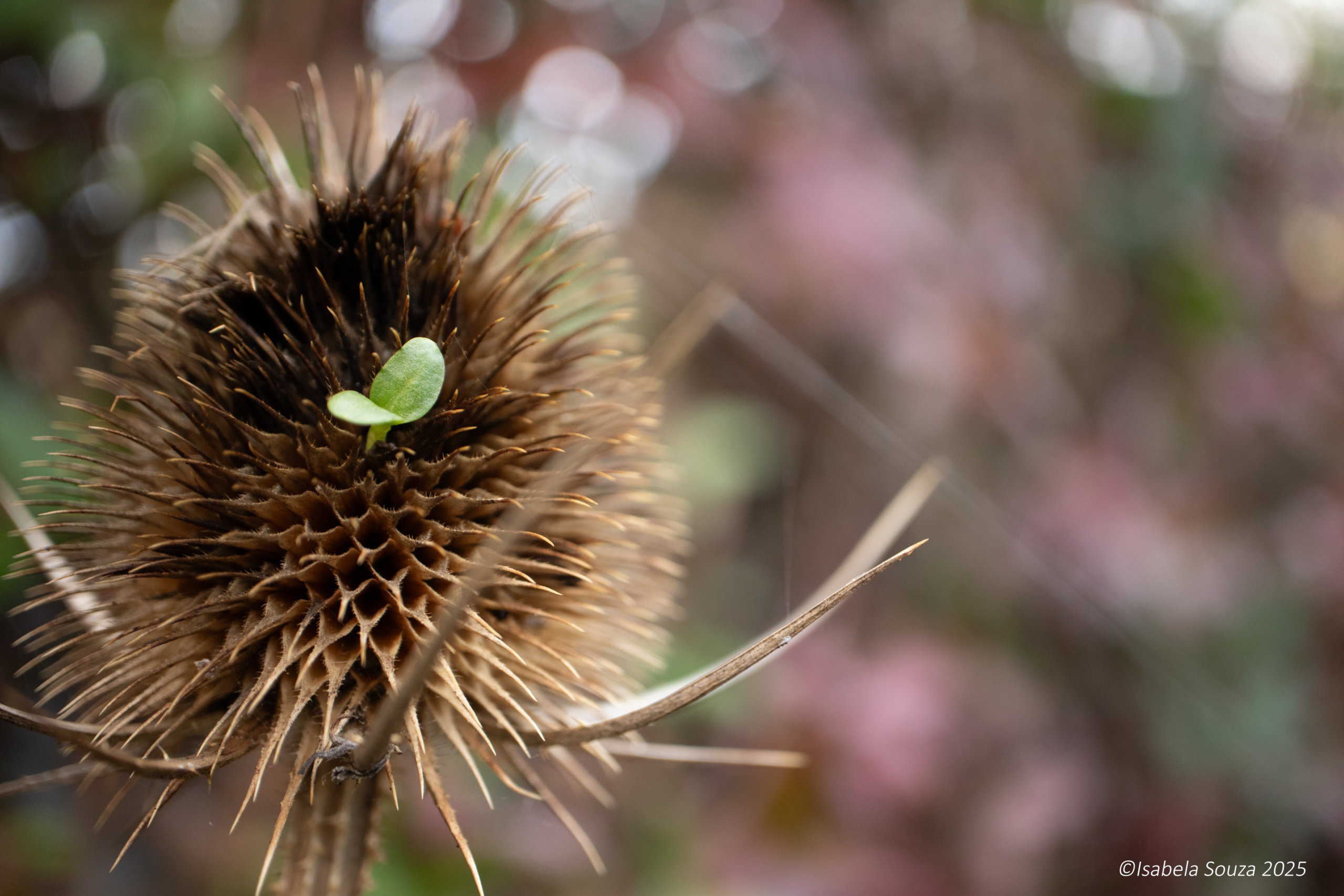
Look closely. From the skeletal, prickly orb of a common teasel’s spent flower head (a structure so dry it rattles in the wind), a single, defiant green root emerges.
Life sprouting not from fertile soil, but from what appears to be a vessel of death. In this quiet paradox, nature offers us our most profound end-of-year reflection:
True resilience is not about waiting for perfect conditions, but about finding the capacity for life within the very architecture of what seems over.
The art of new beginnings
The teasel seed does not wait for spring, nor does it seek ideal soil. When prolonged rain saturates its dry cradle, it interprets this not as a trap, but as a signal. It bypasses dormancy, shifts its internal chemistry, and commits. Its first act is to send a root outward from its safe, dry perch, risking everything on the immediate possibility of moisture and growth.
What a brave and stubborn metaphor for our own spirits. This year, perhaps you have felt like that seed head: weathered, a structure that has borne its season, feeling exposed and fragile. The world’s climate can feel equally arid: marked by conflict, uncertainty, and weariness. The temptation is to go dormant, to wait for a future that promises better, softer ground.
But the teasel teaches another way. It shows that the resources for renewal are often found in the saturation of the present moment… in a lingering conversation, a shared silence, an unexpected kindness, or a simple decision to be gentle with yourself. The “rain” you need may not be a deluge of change, but the steady, soaking persistence of small acts of love and patience.
A strategy for survival
This phenomenon is called precocious germination or vivipary: germination while still attached to the parent. In the common teasel (Dipsacus fullonum), it demonstrates low seed dormancy and a highly adaptive strategy to exploit immediate local moisture. The teasel’s strategy is one of brilliant adaptation:
-
It bypasses dormancy, refusing to let a built-in pause become a permanent stop.
-
It uses what is immediately available, seeing a waterlogged head not as a coffin, but as a first home.
-
It acts with tenacity, its tiny radicle exerting immense pressure to break through its own tough, dry shell.
This is not reckless abandon; it is inherent, adaptable strength. It is the same strength that allows you to offer a kind word when you are tired, to plant an idea when the ground seems frozen, or to choose peace when the impulse might be otherwise.
Our capacity for love and peace is not dependent on perfect circumstances; it is a latent seed, ready to be activated by the nourishment of our own attention and intention.